Tassels, Trimmings and Pom Poms For Autumn Interiors
November 1, 2025
The seasons are changing once more. Autumn colours are on our minds, with a palette of warm blues and greens, and autumn golds mixed with warm russet reds and browns. As the days slowly shorten and the leaves begin to turn and slowly fall around our feet, it is time to usher in the cosy ambiance of autumn into your home.
The seasons are changing once more. Autumn colours are on our minds now, a palette of warm blues and greens, and autumn golds mixed with warm russet reds and browns. As the days slowly shorten and the leaves begin to turn and slowly fall around our feet, it is time to usher in the cosy ambiance of autumn into our homes. Autumn offers a wealth of inspiration for interior design, with rich colours, warm textures, and cosy rooms.
The trees will soon be changing from subtle late summer greens into a canopy of russet reds, golds and burnt orange. Temperatures are already dropping, cooler evenings and the sun low in the sky, sending shafts of light through the tree canopies and hitting that wonderful misty morning light, the signs of colder days to come.
Trimmings add small details, colour, texture, and opulence to a room. Just as we are drawn to warm wool throws and interlined curtains and blinds at this time of year, using trimmings made from natural yarns like wool and cotton will help draw in warmth, a cosy ambience, and add natural understated elegance. Using trimmings in your design projects can make the difference between a good room and a great room.
In this blog, we will explore which trimmings and colours will help transform your living spaces for autumn. Whether you love tassels or beautiful borders, from understated trimmings to sheer opulent eye-catching fringes, discover my favourite design tips to enhance your own scheme.
As with everything designed well, it is all in the smallest of details in interior design that make the most impact.
Helen Izzard is a Somerset based interior design studio, creating timeless, quietly elegant interiors. Our design philosophy is underpinned by our ethos of timelessness, quality, longevity, and craftsmanship. We are drawn to natural materials, which are inherently beautiful, practical and sustainable. Our speciality is bespoke curtains and blinds, using sustainable fabrics from UK independent fabric designers, alongside our Moorland Collection of Artisan British-Made Trimmings.

Autumn trimmings for your interiors project
There is an enduring beauty and timelessness in decorative trimmings when they are used well. They are a small design detail in an overall project, yet they can have a huge impact. As a designer and artisan maker, I know that the small details are the important ones that can pull a design together as one cohesive space.
There are any many different and distinctive styles of trimmings which I discussed in September’s blog post, A Guide to Choosing Trimmings for Curtains, Blinds and Cushions.
The most popular styles will be familiar to you if you already use trimmings in your projects: flat braids, piping cord, fringes and tassels, fan edge, onion tassels, and pom-poms.
Let us look at some of my favourite design ideas using trimmings.
Design Details For Curtains
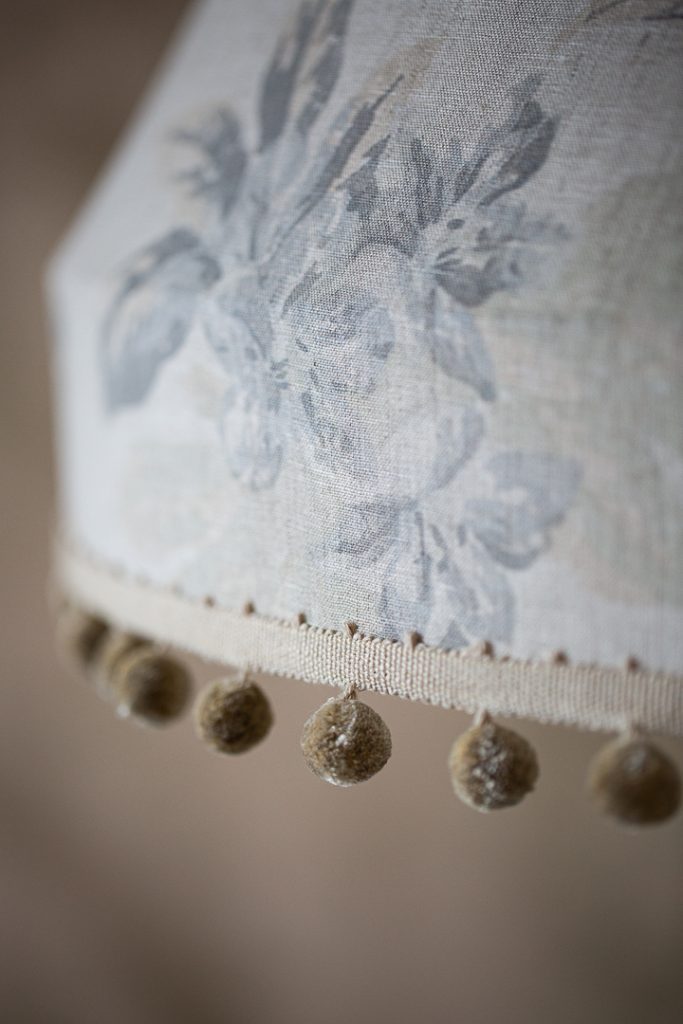
There are many different ways to use trimmings on curtains and pelmets. The leading edges of each curtain can look stunning with onion tassels, pom pom trims, and fan edge trimmings. They soften the edges and add subtle detail. The same trimmings can be used on the bottom of pelmets, whether soft pelmets or firm structured pelmets.
I also use a bias wool edging, so that it is a very wide piped edge, to a shaped firm pelmet in a recent project. The old pelmet was covered in very decorative, almost ostentatious fringe trim, which no longer suited the newly redecorated rooms.
Equally, flat braids also add stunning detail to the bottom edges of a pelmet, whether firm pelmets or softly gathered pelmets which are attached to each curtain. Another option to consider is using flat braids as a border on plain linen curtains. The wide braid can be inset from the edges a little, and add beautiful textural features to a curtain, like a picture frame effect when designed well. I have also crafted a trimming from the same fabric, like a soft gather edging or an inset knife pleated linen trim which sits in from the leading edges.
Design Details For Roman Blinds
Like curtains, I often use onion tassel trims, fan edge trims, and pom pom trims to the lower edges of a roman blind but make sure that the trim detail shows whether the blind is in the closed or open position.
Flat trims work too, either across the bottom edge or as a border, like the borders added to curtains. This looks stunning on longer curtains that are beautifully draped on the floor, in what we call pooling or puddling.
Design Details For Cushions
Decorative cushions are the perfect place for trimmings, whether piped edges, fringes, onion tassels, fan edge trims and more.
I often use flat braids too, as a stunning way to add detail to plain linen cushions. They add textural detail and colour, and you can often use very decorative braids here, as a contrast to the plain linens I use.
Design Details For Room Dividers
Room dividers are both practical and aesthetic at the same time. They are folding screens which are placed to divide larger spaces and work well with stunning fabrics. I love using plain linens and decorate them with beautiful flat braids around the edges, like a border to each frame.
Design Details For Upholstery
Flat braids are my go-to trimmings for upholstery, whether a small dining chair or a larger piece of upholstery. I often scale the braid width to the project, for instance narrow braids to cover the edges of fabrics and wide braids around the edges of boxed cushions, to allow the braid to show when the cushions are placed on the sofa or chair.
Traditionally, long tassel trims were used on upholstery, and I sometimes see them still used, but perhaps less decorative than in previous years.
Design Details For Wall Panel Coverings
This may sound a strange one, but flat braids can look stunning on wall panelling, acting as a border to the wall panels. Wider fabric braids can be used to offset small wallpaper or fabric patterns on walls. It may sound strange but there are fabrics available which are used as wallpapers. My only design tip is to consider the trimmings you plan to use, as they should not overpower the beautiful wall mouldings that are an integral part of the design detail.


My Top Ten trimming colours for autumn interiors
The seasons are once again changing and there are always an excitement and energy around autumn interiors and rich colour schemes. There is a renewed energy in autumn colours, as they create a warm and inviting home. Sometimes, autumn colours can be strong and quite harsh, but autumn also has beautiful earthy colours that can dominate a room scheme but with more subtle muted hues instead.
Paint charts a wonderful way of choosing and mixing colours, and I have added references to paint colours from well-known paint companies below, for inspiration and guidance on tones and hues.
Deep Reds
Use wine inspired reds for autumn, or earthy reds that hold a hint of richer browns, from clarets to deep maroons. Think of Little Green Paints Cherry Red or Bronze Red or Farrow & Ball Preference Red or Eating Room Red for earthy reds.
Deep Pinks
Combining antique pinks with deep reds are always a favourite combination. Consider Edward Bulmer’s Rose or Nicaragua for subtle pinks with hints of grey hues.
Shades of Purples
Strong yet earthy muted purples are one of my favourite autumn colours, as they mix well with warm greys and greens. Consider tones like Little Greens Cordoba or Farrow & Balls Brinjal for some classic beautifully rich yet muted purples.
Earthy Yellow
Yellows are the perfect colour to create energy. Hues of straw and sunflower tones are popular every autumn. Think of Farrow & Ball’s Hay or Sudbury Yellow for uplifting earthy yellows, or Atelier Ellis Sadhika for warm subtle glows.
Deep Brown & Chestnut
Again, one of my favourite colours. Consider shades such as Edward Bulmer London Brown or Atelier Ellis Bitter Chocolate, Jam or Birds Nest.
Earthy Spicy Browns
These tones are much richer vibrant and really compliment the deep browns, purples, and oranges of autumn colours. Little Green’s Middle Buff and Farrow & Balls Bamboozle are deep spicey browns yet subtle and earthy too.
Burnt Orange
Pops of burnt orange add zest and energy, and depending upon your colour preference, add a little of this or lots of orange! Consider Farrow & Balls Charlottes Locks or Edward Bulmer’s Malahide for a more subtle glow.
Warm Dark Blues & Teal
Cool blues can make a room feel very cold and harsh but choosing a warmer hue can add elegance, sophistication, and age to a room. Atelier Ellis have a stunning selection of blue to highlight the right tones: Hummingbird, Baynan Blue, Ede, Ink, Plume, Sumira to name a few.
Warm Greys
Like blue tones, choosing a cool grey can simply drain a room, making it feel cold and empty. Farrow & Ball’s French Grey has been a timeless warm grey used by many of us, as well as Mizzle and Cromarty.
Forest Green
My final choice of autumn colour has increased in popularity over the past few years and is considered a timeless and elegant. Consider tones such as Atelier Ellis Totara, or Farrow & Balls Bancha, Studio Green, Beverly, or Sap Green.
Why details make a difference
Details are important and will always make a difference, but especially so in interior design projects. The attention to detail is what makes every design unique and intentional. Intricate details like adding beautiful linings, interlining our bespoke blinds curtains, and matching pattern repeats perfectly so the patterns flow seamlessly. Choosing just the right curtain pole in the perfect colour and style… these are just some of the fine details that helps to elevate a simple room to an extraordinary space.
One of my favourite details are trimmings. Trimmings are the best way to add unique custom finishing touches. This can be adding trimmings to the leading edge of curtains and blinds, adding beautiful braids and fringes to upholstered chairs and sofas, using fan edge or tassels on the edges of cushions and throws…. The choice is simply endless.


Trimmings crafted from natural wool. Why does wool matter?
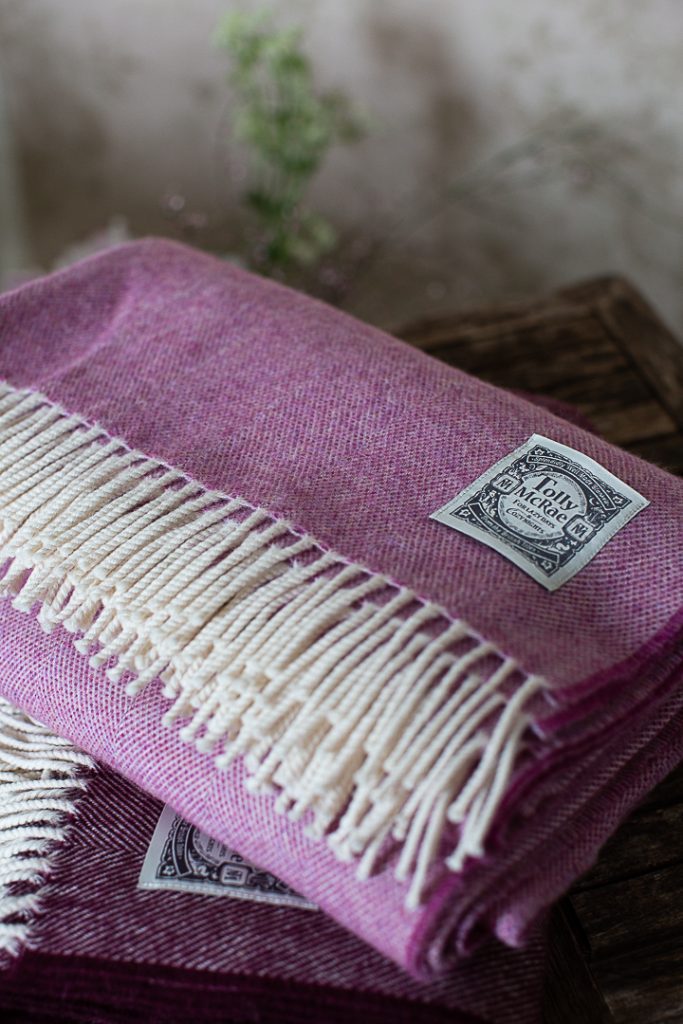
So why does wool matter and why use this fibre to craft heritage trimmings? Wool has been used since around 9000BC and it was known to provide us with our first woollen clothing.
With the invention of plastics in 1907, followed by nylon in 1935, both these synthetic fibres were created to maintain the availability of natural resources. Now, we find ourselves in a world where 69% of global fibre production is made from synthetic oil-based materials, which remain in landfill sites for decades as they do not decompose.
Wool is an undervalued fibre, yet one of the best ecological and bio-degradable fibres we have to hand. Wool is part of a circular natural resource system, in that as a naturally biodegradable fibre and can be returned to the earth, wool is slowly proving to be one of the most important fibres in the textile industry targets towards creating a more sustainable industry.
I have written more on incorporating natural wool in to our homes in last month’s journal In Celebration of October Wool Month.
Why should you choose British made trimmings for your interior projects?
The UK textile industry is one of the oldest and most important industries across the world, with centuries of experience and knowledge at our fingertips. Sadly, many of the trimmings available in the UK are imported and the increase in imports over the past few decades has been detrimental to the textile industry and we have seen many companies close their doors. In recent years though, there has been a growing interest in buying bespoke hand-crafted goods, including trimmings, and as we know, the UK has a long and incredibly important history of producing high-quality textiles.
Supporting the UK textile and trimmings industry does not just preserve traditional skills and workmanship, it also ensures greater sustainability and ensures we continue to have thriving industry with bespoke hand-crafted products to offer.
From my experience, there is nothing to match British made trimmings in terms of their quality and design, in comparison to imported trimmings. I have experienced first hand the inferior quality of imported trimmings: product quality is vastly inferior, and quality can change from batch to batch, alongside the same dye lots ranging in colour from one batch to another, often to quite an extreme. In some countries, the yarn dying process is not regulated, which can lead to toxic chemicals being used, and dyes can often fade very easily.

As with all design details, the most important tip to consider is to allow creativity and design to guide your decisions and most importantly, be guided by your interior designer if you are using one.
Trimmings can enhance your designs when used well. Trimmings can have huge impact and allow you to create something unique to you.
They can transform a room entirely.
Have you also seen our Moorland Collection of Trimmings? They are designed and hand crafted in the UK using only natural cottons and wool yarns.
I took time to create this collection, with a thoughtful & considered approach to selecting the weavers we work closely with, and choosing the finest natural cotton and pure wool yarns, to create a bespoke hand-crafted collection of English trimmings that add understated style, design and texture to soft furnishings and interior design.
With an intentional commitment to sourcing locally and sustainably by supporting British manufacturing, our trimmings are entirely and exclusively handmade for us in the UK.
We also offer a bespoke colour service if you would like a specific colour to match your project.
I hope you have enjoyed reading this article and have discovered why trimmings can add small details, colour, texture to your interiors. If you would like help selecting trimmings, curtains and blinds for your home do get in contact with me.
Our trimmings are available by the metre with a minimum of one metre and in half metre quantities thereafter. You can also order samples, which are useful to check the colours and size.
If you are planning to start an interior design project and would like some help, please get in touch to discuss your ideas and how we can help you. You can also follow us on Instagram or sign up to our regular newsletter to receive interior design news, inspiration, tips and offers directly in your inbox.

British-Made Trimmings For Interior Design
FAQ: The three most commonly asked questions about our beautiful trimmings.
Why is it important to buy British-Made trimmings?
British trimmings or Passementerie as it is also known, are classed as an endangered craft in the UK by the Heritage Crafts Association. British trimmings are a rare art, as many trimmings available are imported and made from manmade fibres. The factory we use for our trimmings has three generations of looms still in use, the oldest has been in use for over 100 years. While the loom is responsible for the weaving, the craftsperson sets the looms up and oversees every metre woven.
We are incredibly proud to play our small part in keeping this craft alive.
Are British-Made trimmings expensive?
The simple answer is No. They are crafted for longevity, made from colour fast good quality yarns, and made by artisanal crafts people. And most importantly, they are designed and made for us in the UK.
Can I order trimming samples before buying?
Yes! We encourage you to buy a sample first. We offer samples of all our trimmings as it is important to check both the colour and design before ordering.


